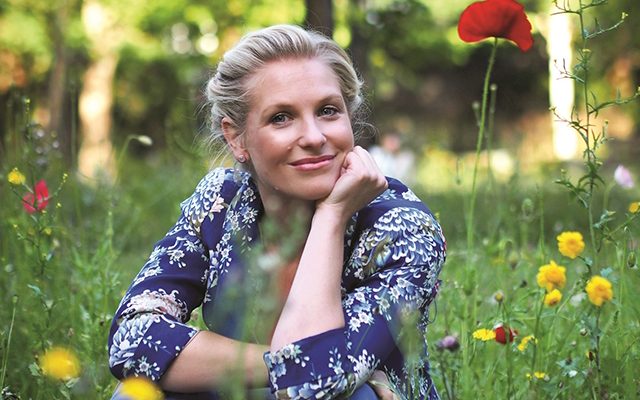
Obviously there are not a lot of lilacs to be gathered in the middle of Dewsbury, this was the title of the latest in the Kirklees Concert Season from Opera North. It was a collection of English songs, although that was stretching things just a touch in a couple of cases.
Traditional, and not so traditional, English songs at lunchtime, performed by a soprano and pianist after a plate of triangular-shaped sandwiches, a bowl of soup and a (paper) cup of tea; could anything be more civilised? OK, perhaps a china cup and the crusts cut off of the sarnies, but, hey, who cares, the sun was shining through the windows of the auditorium and the performers were Ellie Laugharne and David Cowan, making us forget that it was October rather than June and we were in an industrial town as opposed to a village hall in the Dales.
Ms Laugharne is a soprano who has won several major prizes and is an Associate Artist for Opera North as well as being a Samling Artist and a Company Artist for the Mozartists – great name. Mr Cowan has been Head of Music at Opera North since 2015 before which he held prestigious posts at opera companies throughout Europe.
On entering the building we were provided with a programme containing the running order and the artists’ biographies. Whilst enjoying the fare before the performance we were also given a song sheet containing all of the lyrics. This took the edge off my appetite somewhat, being concerned that we may be encouraged to join in with the vocals, but I was soon reassured that the paper was only to help us follow the songs.
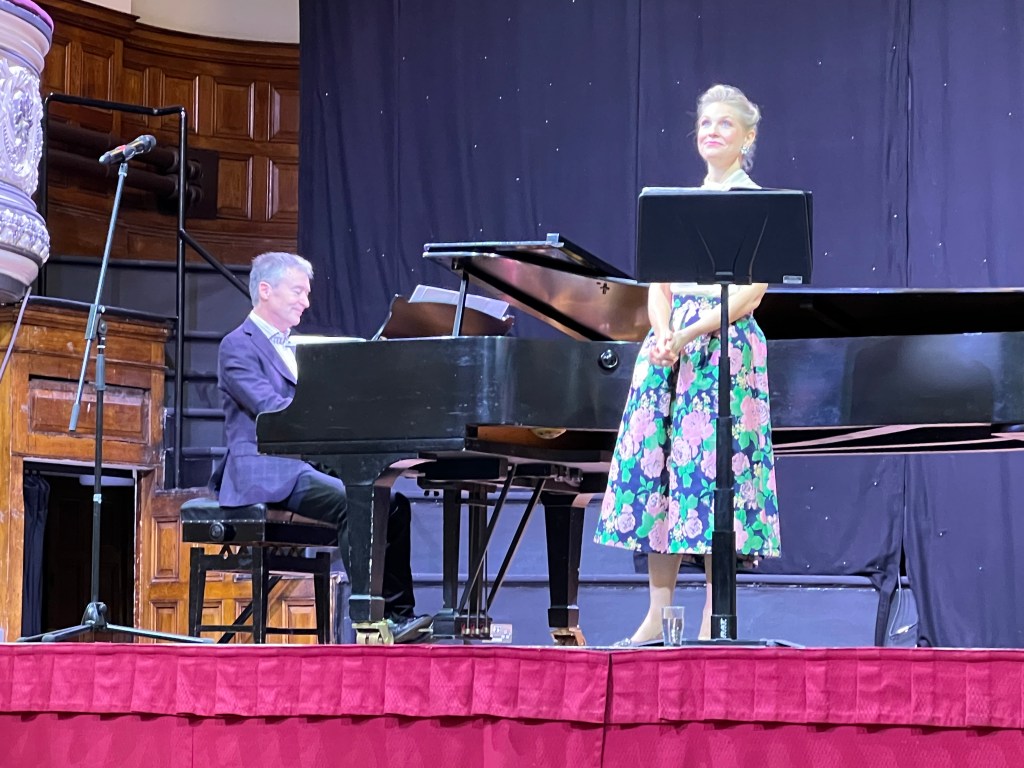
The first piece could not be more English, Thomas Arne’s setting of the William Shakespeare text from The Tempest, Where The Bee Sucks. This is obviously written in language from another era but none the worse for that. It also highlighted the mischievous side of Ellie Laugharne’s delivery, which was very expressive throughout the concert.
This was followed by Six Songs op.16 by Gustav Holst. The pieces covered the subjects of grief and love. I seem to be going to a lot of events about grief lately. I have come to the conclusion that old people – and I can speak with authority here, being one myself – become grumpier and more cantankerous as we age because, being of the opinion that the world is rapidly going to rack and ruin eases the thought of our impending demise. It gets us thinking that death might not be such a bad thing after all. It seems the poet Alfred Henry Hyatt agrees with me, for it is his words which have been set to music by Holst, as it begins ‘The toll of the day is done, its stress and stirring cease.’
Next up was King David, written by Herbert Howells to the words of Walter de la Mare, who, we were informed by the singer, would not allow it to be used by anyone else as he deemed it ‘perfect’. This was followed by another of Howell’s compositions, Come Sing and Dance. We will never know what the writer of these words thought of this musical setting because it was by that prolific lyricist and poet, anon.
The programme continued with Three Early Songs by George Crumb; two with words by Sara Teasdale and one by Robert Southey. Crumb wrote them to be sung by his girlfriend, later to become his wife. She must have been a very tolerant woman as he said that hers was not the best-trained voice he had heard, so made the pieces more folky to compensate for her lack of range. I suppose it is the musician’s equivalent to telling his girlfriend that, yes, your bum does look big in that dress! Fortunately we had Ellie Laugharne singing so it sounded superb.
A poem by Dante Gabriel Rosetti, called Silent Noon, with score composed by Ralph Vaughan Williams restored the romance by describing the feelings of two young lovers lying in the grass on a summer’s day.
It was then the turn of Gilbert and Sullivan with their song, The Sun Whose Rays, from The Mikado. I am not a big fan of G&S – G&T yes – so I was appreciative of the excerpt from the script leading up to the piece, being quoted by Ms Laugharne. My natural aversion to the composers being allayed for a couple of minutes by her wonderful performance.
Here comes the odd one out round. I Could Have Danced All Night from My Fair Lady by Lerner and Loewe. Although the musical could not be more English, Lerner was American and Loewe was born in Berlin and moved to the USA. It is such a good song and was so well performed that, what the heck. It was introduced by David Cowan who said they were doing it as Opera North was in collaboration with Leeds Playhouse to stage the musical next year. That is one for the diary.
Finally, we come to the eponymous song, We’ll Gather Lilacs by Ivor Novello, who was Welsh but I was passed caring where they came from, just as long as they kept coming! For those who don’t know, the song was written in 1945 and is about the longing for loved ones to be reunited when they came back from the war. I have no need to tell you about the performance as I found this clip by Ellie Laugharne on YouTube so you can enjoy it as well. The pianist is not David Cowan, but you can’t have everything. https://www.youtube.com/watch?v=Gn2XsLG-KPg
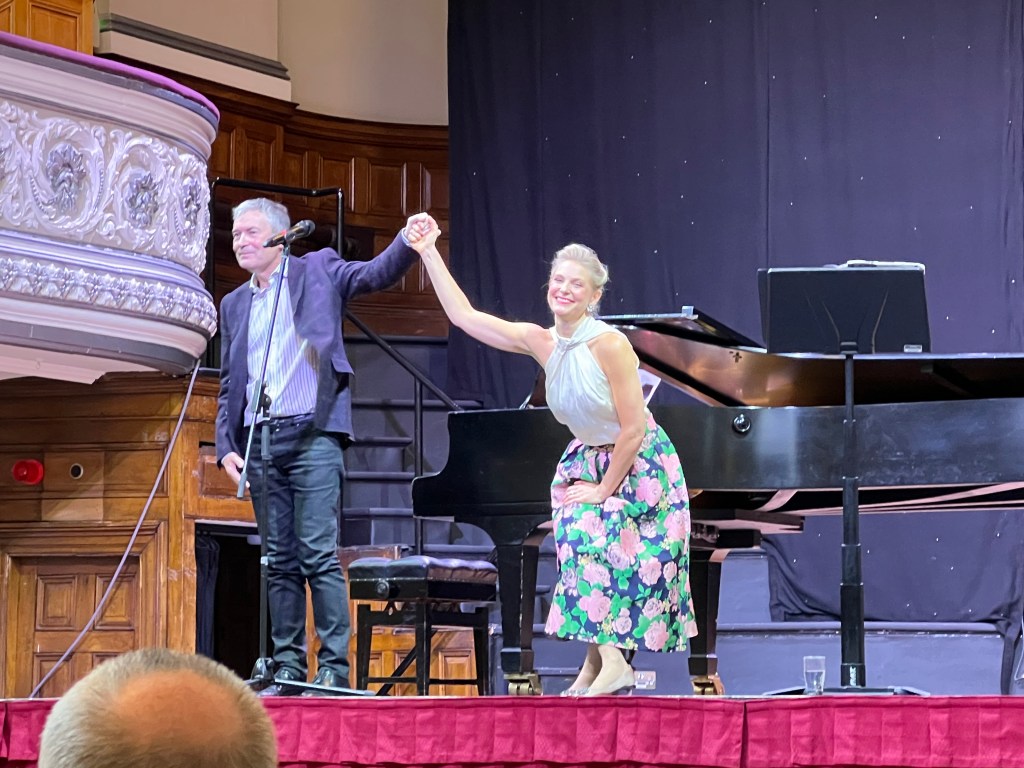
The great thing about watching an opera singer in concert is that they perform the songs as much as sing them thus giving the whole thing much greater variety. It goes without saying, but it would be rude not to, that David Cowans accompaniment was sublime, although his filing system could do with a bit of refining; we had a sheet music malfunction.
So, another extremely pleasant lunchtime, all that was left was to brace for the culture shock of emerging into the early afternoon of a Dewsbury October rather than the sun soaked lanes of Grassington. Either way, you can’t beat Yorkshire.
For more details as to the Kirklees Concert Season please go to https://www.operanorth.co.uk/kirklees-concert-season/
For other Opera North productions it is https://www.operanorth.co.uk/
Feature photograph provided by Opera North. Other photographs by Stan Graham

